How do influencers make money in 2026? The 9 real income streams (with numbers)
A no-fluff breakdown of every way influencers actually get paid — brand deals, affiliate, UGC, digital products, subscriptions, ad revenue, licensing, appearances, and consulting — with real 2026 rate ranges.
By Priya Sundaram
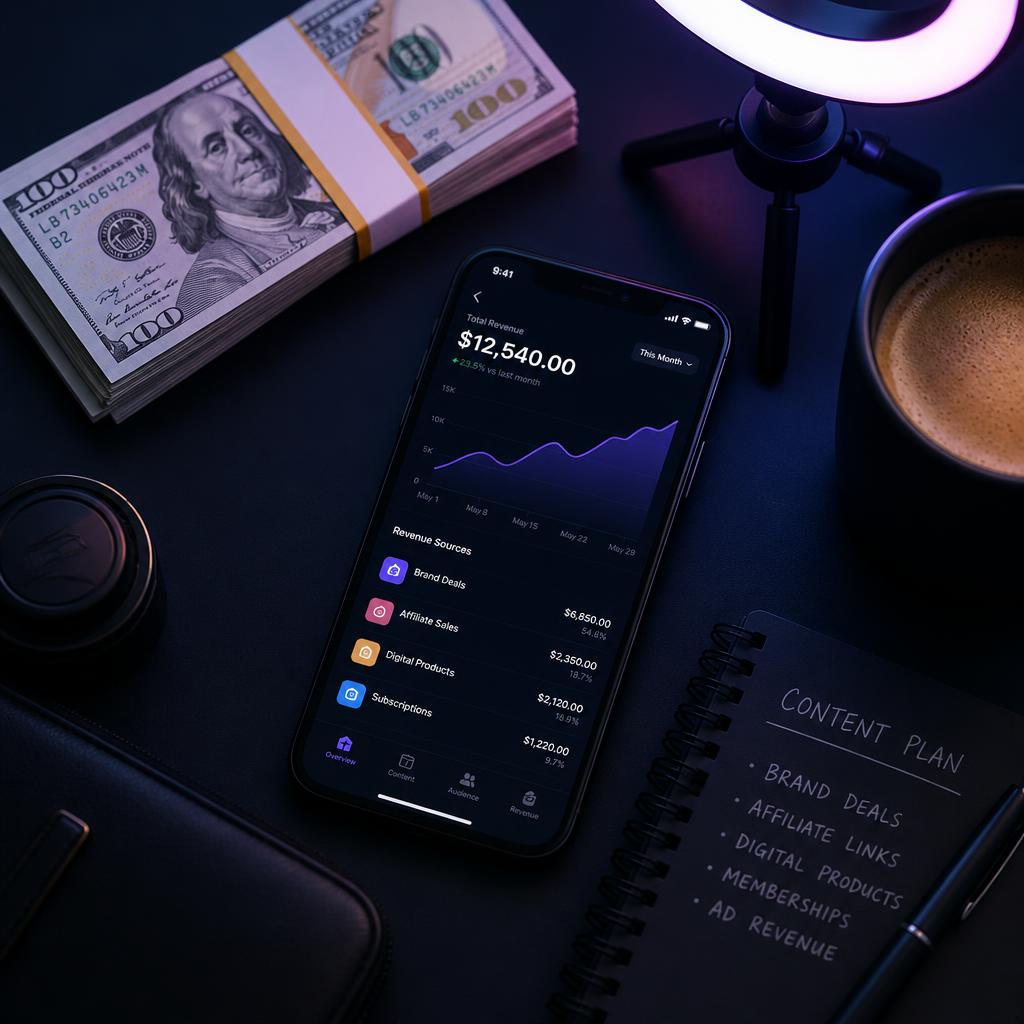
If you've ever wondered how influencers make money — really, line-by-line, not the vague 'they get sponsorships' answer — this guide is the one to bookmark. The short version: modern creators don't have one income stream, they have a stack of them. A working mid-tier influencer in 2026 usually earns from six to nine different sources at once, and the mix (not any single deal) is what turns content into a business. Below is every stream that actually pays, what it pays in 2026, and how to unlock it whether you have 2,000 followers or 200,000.
1. Brand deals (sponsored posts). The most visible income stream. A brand pays for a dedicated post, Reel, TikTok, YouTube integration, or Story. Typical 2026 flat rates: nano creators (1K–10K followers) $50–$300 per post; micro (10K–100K) $250–$2,500; mid-tier (100K–500K) $2,000–$10,000; macro (500K–1M) $8,000–$25,000; celebrity tier (1M+) $20,000–$500,000+. The single biggest lever isn't follower count — it's engagement rate and conversion history. A 40K creator who can prove past sales will out-earn a 400K creator who can't.
2. Affiliate marketing. You share a tracked link or code; you earn a percentage of every sale. This is where 'how to make money as an affiliate marketer' and influencer income overlap directly. Commission rates in 2026: physical products 3–15%, digital products 20–50%, SaaS 20–40% recurring, finance/insurance $50–$500 per qualified lead, high-ticket B2B $500–$5,000 per closed deal. Affiliate income compounds — a review video you posted 18 months ago can still pay you every month. It's the closest thing creators have to passive income.
3. UGC (user-generated content) production. Different from a sponsored post: the brand pays you to produce content they run on their own channels, usually as paid ads. You may never post it to your own feed. 2026 UGC rates: $150–$500 per short-form video for nano creators, $400–$1,500 for micro, $1,000–$4,000+ for experienced UGC pros. Add 30–100% for usage rights (paid-ad license) and another 20–50% for exclusivity. UGC is the fastest way for creators under 10K followers to make real money — you're selling production skill, not reach.
4. Digital products. Presets, LUTs, Notion templates, Lightroom filters, ebooks, courses, prompt packs, stock footage. Margins are 90%+ once built. A creator with 20K engaged followers can realistically clear $2,000–$10,000/month on a $27–$97 product with a decent funnel. Courses at $200–$2,000 scale higher but require a stronger audience relationship. This is the income stream that survives platform algorithm changes because you own the customer.
5. Paid subscriptions & memberships. Patreon, Substack, Instagram Subscriptions, YouTube Memberships, Twitch subs, TikTok Series, Ko-fi. Average paying-fan conversion is 1–5% of an engaged audience at $5–$15/month. A creator with 30K real fans and a 3% conversion at $8/month is looking at ~$7,200/month recurring — before any brand deal. Subscriptions are the quietest but most durable creator income stream in 2026.
6. Platform ad revenue. YouTube AdSense pays roughly $2–$20 per 1,000 monetized views depending on niche (finance, SaaS, and B2B pay the highest; entertainment and gaming the lowest). TikTok's Creator Rewards Program pays roughly $0.40–$1.00 per 1,000 qualified views on 1-minute+ videos. Instagram and Facebook pay through Reels bonuses and in-stream ads on longer video. Ad revenue alone rarely makes a creator rich, but it's a real floor — a 500K-view YouTube video in a finance niche can pay $3,000–$8,000 in AdSense on top of any sponsor.
7. Content licensing. When your video goes viral, licensing agencies (Jukin, ViralHog) and brands will pay to re-use the clip in ads, TV, and social. Typical viral-clip license: $500–$5,000 one-time, sometimes $10,000+ for national ad usage. Set this up once via a licensing agency and it runs in the background.
8. Appearances, speaking, and events. Meet-and-greets, panel talks, brand activations, conference keynotes. Rates in 2026 range from $500 (local meetup) to $50,000+ (headline keynote for a public figure). This stream unlocks around the 50K–100K follower mark in most niches and much sooner in B2B/finance/tech.
9. Consulting and done-for-you services. Once you've built an audience in a niche, brands and other creators will pay you to advise them. Rates: $150–$500/hour for consulting, $2,000–$25,000/month retainers for social media strategy, $5,000–$50,000 for full creative direction on a campaign. This is the highest-margin income stream on the list — no platform takes a cut and there are no production costs.
How much do influencers actually make? Real 2026 ranges, all streams combined: nano (1K–10K) $0–$2,000/month; micro (10K–100K) $500–$10,000/month; mid-tier (100K–500K) $5,000–$50,000/month; macro (500K–1M) $20,000–$150,000/month; top 1% $200,000+/month. The spread inside every tier is enormous — the deciding factor is whether the creator treats it like a business (multiple streams, tracked conversions, clean rate cards) or a hobby (one platform, one income stream, DM negotiations).
How to unlock these streams if you're starting today. Pick one niche narrow enough that a brand can describe your audience in one sentence — 'B2B SaaS buyers,' 'first-time homebuyers in Texas,' 'cybersecurity engineers.' Ship two pieces of content a week for 90 days. Add affiliate links to everything reviewable from day one. At 2K–5K engaged followers in a B2B or high-CPM niche, you can start pitching UGC and small brand deals. At 10K, you have leverage. The follower count that matters isn't 100K or 1M — it's the number at which you've proven you can move product.
Where SocialMynt fits. Most creators leave potential income on the table because they only run one or two streams — usually brand deals and AdSense. SocialMynt adds commission-based affiliate campaigns from SaaS, cybersecurity, finance, and B2B brands, with tracked conversions and visible commission statuses. No 100K follower gate — brands filter on real engagement and past conversions.
The one-line answer to 'how do influencers make money?' — they stack 6–9 income streams on top of the same audience, and the creators who take it seriously as a business out-earn creators twice their size who don't. Pick two streams to add this quarter, wire up clean tracking, and the income math starts working in your favor.